Musicmap: the family tree of pop music
Musicmap lays out popular music as one giant chart — from blues and gospel to techno and emo — on a timeline from the 1880s to the 2020s, showing what grew out of what.
What it is
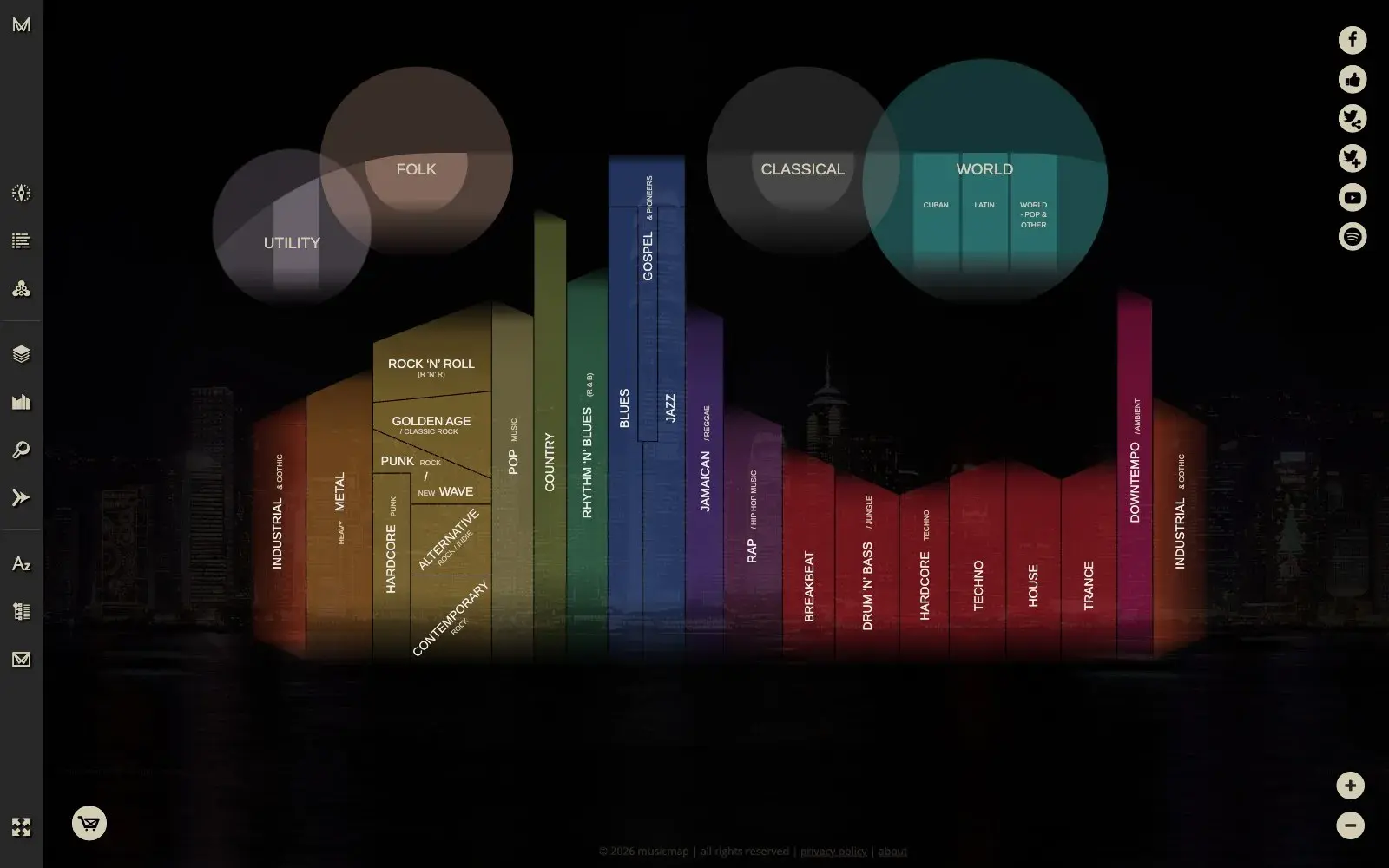
Musicmap is an interactive family tree of popular music genres. The home page is one enormous chart that looks a bit like a subway map. Across the page run the big families — rock, metal, punk, pop, country, R&B, blues and jazz, Jamaican music, rap, breakbeat, drum 'n' bass, house, techno, trance, downtempo. Down the side runs a timeline from the 1880s to the 2020s. Inside each family sit dozens of subgenres: shoegaze, post-rock, synthpop, new wave, grunge, math rock and many more.
Latin and Cuban music, folk, classical and world music get their own blocks. The makers pitch it as an educational tool, pulling together relations between genres, their history, social context and music examples in one place.
Why we picked it
Genre arguments usually end in "that's not real punk." Musicmap skips the argument and shows the lineage: how blues and gospel fed R&B, and how R&B fed half of everything after it. The chart is huge but readable, with color-coded families, lines of influence and decades you can scan at a glance.
It also says plainly that it's ad-free, and it ends with a long bibliography of the sources the chart was built from. For a topic this contested, showing your work matters.
Where to start
- Find the genre you listen to most and follow its lines back to the roots.
- Pick one decade on the timeline and count how many genres were born in it.
- Compare two neighbors, say house and techno, and see where they split.
- Scroll to the folk, Latin and world music blocks at the bottom.
Who it's for
Music nerds who like digging into where sounds come from. DJs and musicians who get asked "so what kind of music is it?" Teachers and music writers who need a clear visual. And anyone stuck in a playlist rut — the chart is a great way to find what to listen to next.
Quick answers
Is it free? Yes, the map is free to explore; there's a separate store selling prints of the chart.
Does it cover classical or non-Western music? Classical, folk, Latin and world music have their own sections, but the main focus is popular music.
Does it show ads? The site states it's ad-free.