The True Size Of
Drag a country across the map and watch it change size — the quickest way to see how the Mercator projection inflates Greenland and shrinks Africa.
What it is
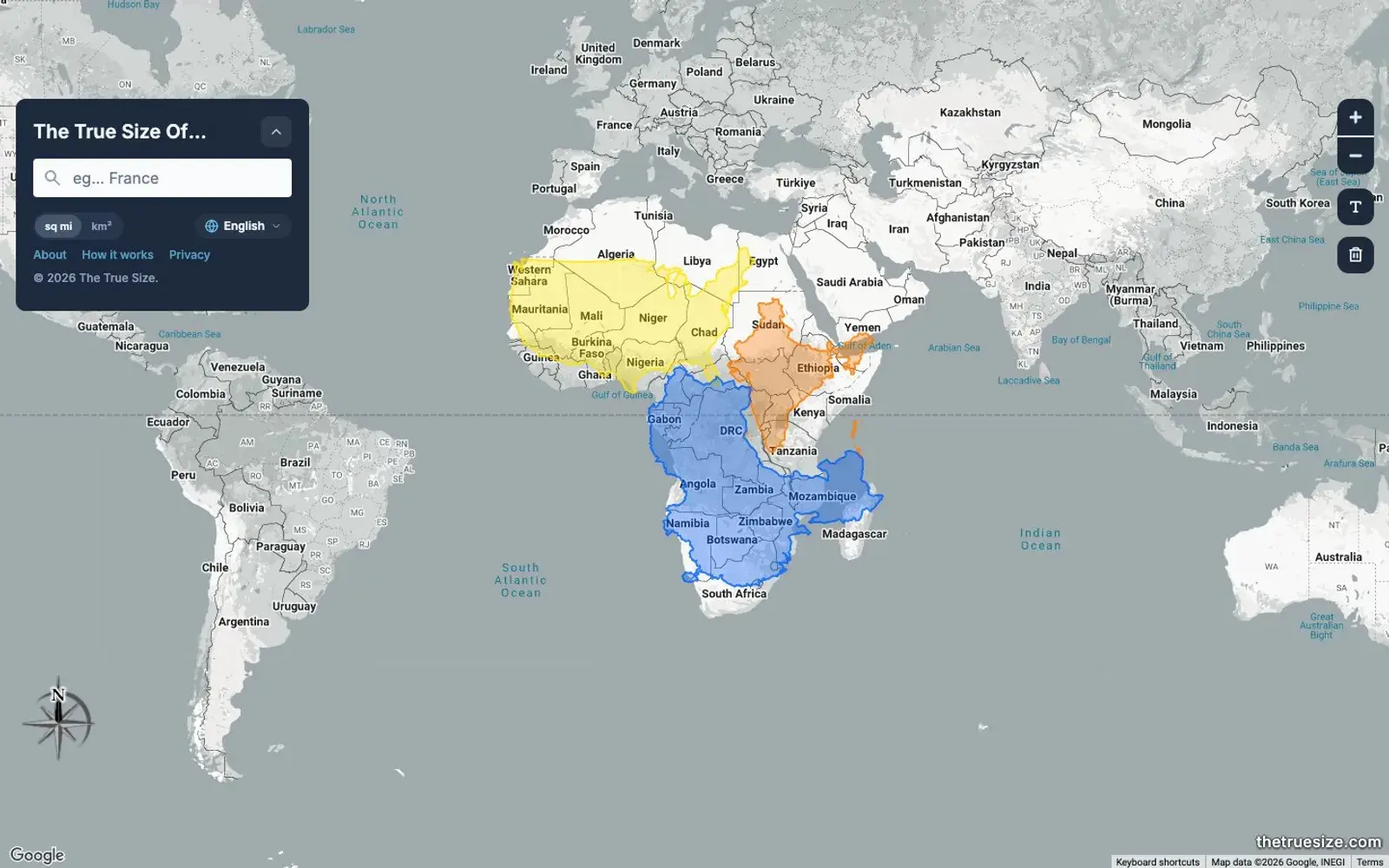
The True Size Of is an interactive map that breaks your mental picture of how big countries are. Type in a country, state or region, its outline appears on the map, and you can drag it anywhere in the world. Move it toward the poles and it swells; move it toward the equator and it shrinks. It's the plainest possible demonstration of how much the standard world map distorts reality.
Why we picked it
Everyone grew up with a map where Greenland looks about as big as Africa. According to the site's creators, Africa is actually around 14.5 times larger. The culprit is the Mercator projection: great for navigation, but it stretches everything far from the equator. Explaining that in words is dull; dragging Greenland down to the equator once makes it stick for good. Then the fun starts. What does Russia look like dropped onto Africa? Does Kyrgyzstan fit inside the UK? How big is Antarctica really? The site does exactly one thing and does it well, and its makers pitch it openly as a tool for geography teachers.
Where to start
- Find Greenland and drag it onto Africa.
- Pull Russia or Canada down to the equator and see how much is left.
- Lay your own country over a neighbour or over Europe.
- Try the popular pairs: Japan vs the UK, Brazil vs Australia, Australia vs India.
Who it's for
Geography teachers and students — it's a ready-made five-minute classroom experiment. Map lovers and travellers. And anyone who wants ten minutes of procrastination that actually teaches something.
Quick answers
Why do countries change size when I drag them? The site recalculates each shape for the Mercator projection, which stretches land closer to the poles.
How much bigger is Africa than Greenland? Roughly 14.5 times, according to the site's own explanation.
Who made it? It was created by James Talmage and Damon Maneice, as credited on the site.