Molecule of the Month
One molecule of life each month since 2000: an illustrated, readable story plus a 3D structure you can spin in your browser.
What it is
Molecule of the Month is a long-running series on PDB-101, the education site of the Protein Data Bank — the global archive of 3D structures of proteins and other biological molecules. Every month there's a short article about one molecule or family of molecules: what it does in the body, how it's built and why it matters.
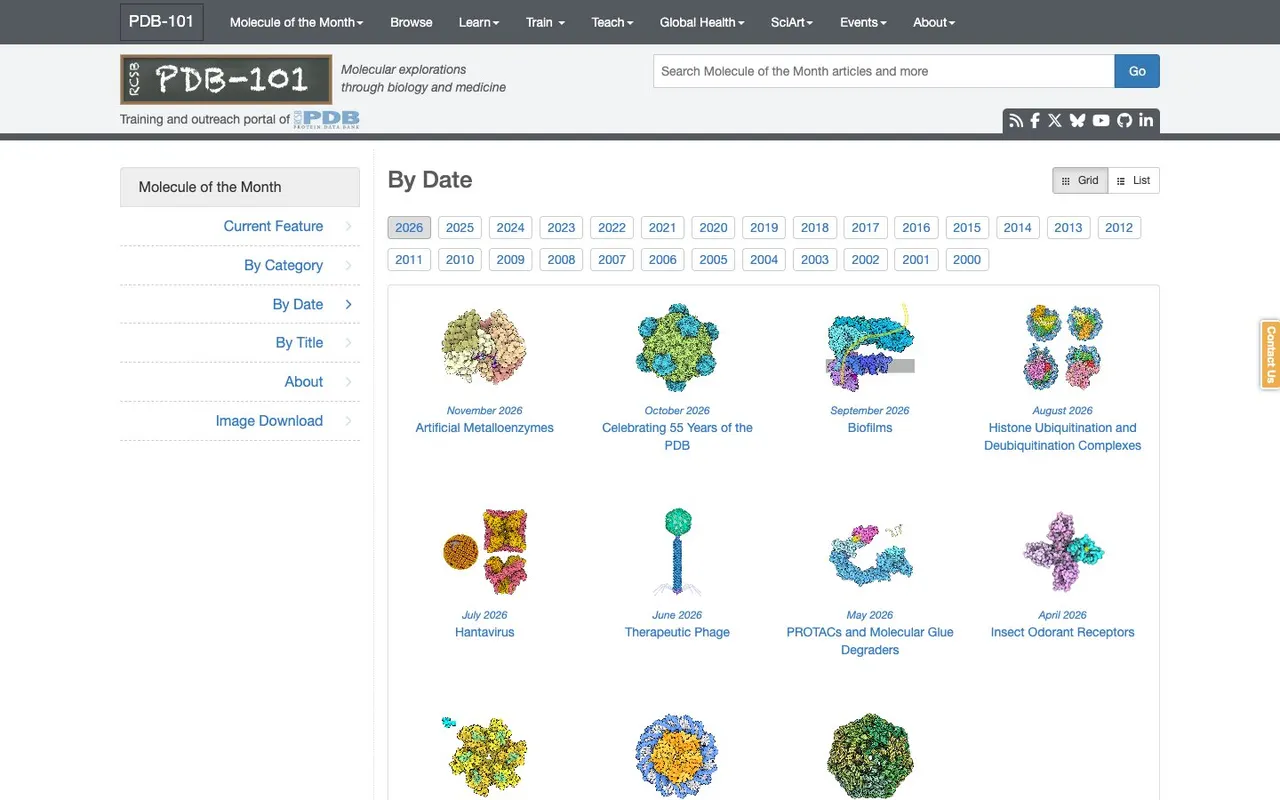
It's been going since 2000. David Goodsell, the scientist-illustrator known for his soft watercolor cutaways of crowded cells, wrote it until 2024; since January 2025 Janet Iwasa of the University of Utah has carried it on. The October 2026 entry marks 55 years of the PDB itself; before that came biofilms, hantavirus, and phages used against antibiotic-resistant bacteria.
Why we picked it
It's a rare science resource that explains hard things without dumbing them down, and looks good doing it. Take the October 2025 entry on incretins: GLP-1 and GIP are hormones released after you eat a meal that prompt insulin release. The article walks through how their receptors pass the signal into the cell, then takes a detour to the Gila monster, whose venom contains a longer-lasting GLP-1 lookalike that became a diabetes drug.
Every article has an Exploring the Structure section with an image tab and a JSmol tab, so you can rotate the actual structure in your browser. Below that you'll find discussion topics, links to related entries, the real PDB IDs and references, and several figures are available as high-resolution downloads. A quarter-century of back issues adds up to hundreds of entries, and most of them hold up well.
Where to start
- Open the list by date and pick something from the last few months.
- Switch to browsing by category if you're after a theme: Health and Disease, Molecules of Life, Biotech and Nanotech, or Structures and Structure Determination.
- In any article, click the JSmol tab and turn the molecule around.
- Dig out an early Goodsell entry, like trypsin from 2003, to see how the series has evolved.
- Sign up for the newsletter or RSS feed if you want each new molecule as it lands.
Who it's for
Biology and chemistry students, teachers looking for lesson material (some entries suggest classroom activities and paper models), healthcare people, and anyone who has nodded along at words like "receptor" or "enzyme" without quite picturing them. The partner project PDBj translates the series into Japanese, Chinese and Korean.
Quick answers
Do I need a biochemistry background? No. The articles are written for a general audience, though you'll meet some technical terms.
Can I use the images in class? The site offers high-resolution image downloads and explains how to cite them.
How often does it come out? Once a month, every month since 2000.