Seeing Theory: statistics you can see
A visual introduction to probability and statistics from Brown University: flip coins, drop balls and watch the rules emerge before you ever see a formula. Available in English, Chinese and Spanish.
What it is
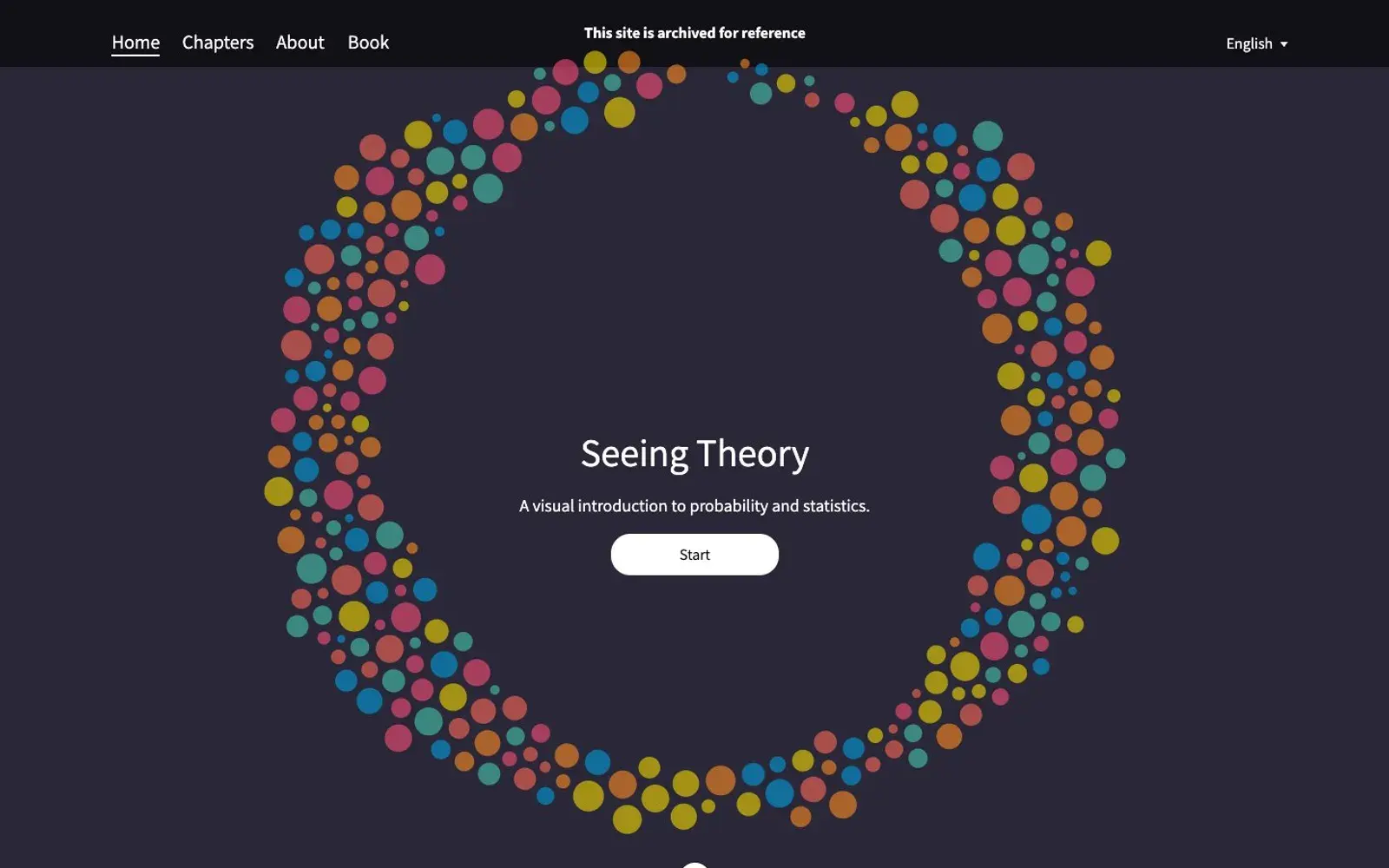
Seeing Theory is a visual introduction to probability and statistics. Daniel Kunin started it as an undergraduate at Brown University, and a small team has worked on it since. There are six chapters: basic probability, compound probability, probability distributions, frequentist inference, Bayesian inference and regression analysis. Everything is built around interactive animations, and the site comes in English, Chinese and Spanish.
Why we picked it
Statistics usually gets taught through formulas, and for a lot of people it never becomes more than a pile of symbols. Seeing Theory flips that. First you flip a coin hundreds of times and watch the share of heads settle toward one half, then you drag sliders and watch a distribution change shape, and only then do you read a short explanation. The central limit theorem, which sounds intimidating in a textbook, turns into falling balls stacking up into a bell curve.
The project has picked up recognition along the way, with the site mentioning honors including the Webbys and the Information is Beautiful Awards. There's also a draft textbook to download if you want to keep going once the formulas stop being scary.
Where to start
- Open chapter one and play with the coin and dice; it's a warm-up.
- In chapter two, try conditional probability, which finally becomes visual here.
- In the distributions chapter, find the central limit theorem demo.
- Visit the Bayesian inference chapter to watch a prior shift as data comes in.
- If you want more depth, download the draft textbook.
Who it's for
College students wrestling with a stats class, high schoolers, teachers who need a visual for a lecture, and adults who'd like to finally understand what a p-value or a confidence interval actually means.
Quick answers
Do I need strong math? High-school math is enough for the early chapters. The animations explain the idea before the notation shows up.
Is it free? Yes, the whole site is free to use in the browser.
Who made it? Daniel Kunin, who started it while studying at Brown, later joined by other contributors.