Old Bailey Online: London's court records, 1674–1913
A fully searchable archive of London's central criminal court: over 197,000 trials from 1674 to 1913, told largely in the words of the witnesses and defendants themselves.
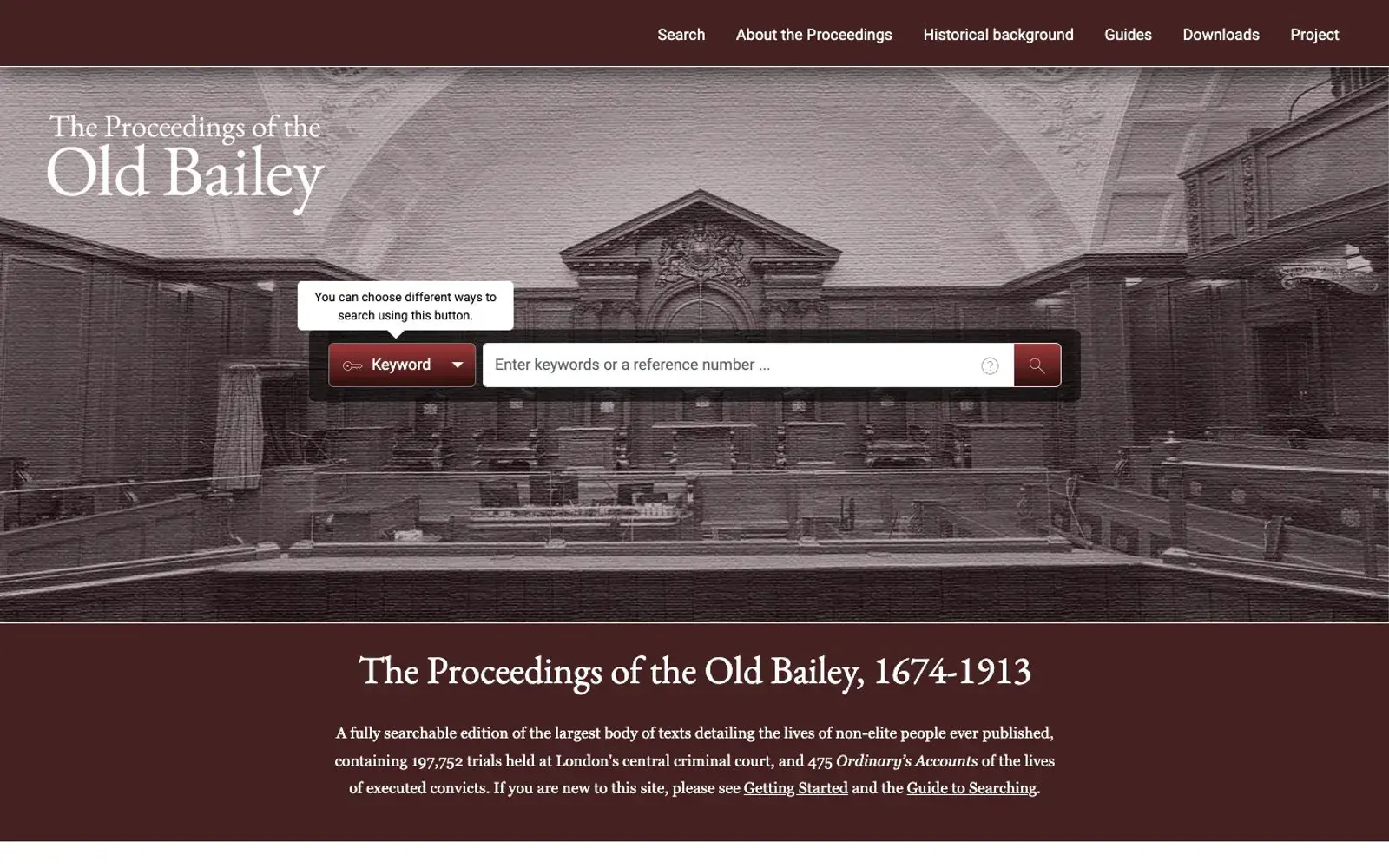
What it is
Old Bailey Online is the digitized record of the Old Bailey, London's central criminal court. It holds every surviving edition of the Proceedings from 1674 to 1913, more than 197,000 trials, plus the Ordinary of Newgate's Accounts, the prison chaplain's write-ups of the lives of executed convicts. The project calls it the largest body of texts about the lives of non-elite people ever published. It launched in the early 2000s, and a major new version came out in 2023 with a mobile-friendly design and better search.
Why we picked it
History tends to get told through kings and generals. Here the voices belong to maids, cabmen, pickpockets, shopkeepers and their neighbors, recorded almost word for word in the courtroom. Piece their testimony together and you get a living London: what people wore, what things cost, where they drank and how they swore.
We love the "On this day" feature on the homepage, which pulls up a trial from the same date. The day we checked, it was a 1742 case about a highwayman who left his victim enough cash to buy drinks later, shown next to a scan of the original page.
Search is flexible: keywords, names, crime, verdict and punishment, dates, plus a statistics tool. Fair warning: the site carries ads, and plenty of these stories end in harsh sentences.
Where to start
- Read the "On this day" trial on the homepage.
- Run your surname through the name search.
- Pick a year and browse trials in order; it's like reading a newspaper from the time.
- Dip into the historical background pages on London, policing and punishment.
- Read a few of the Ordinary's Accounts, short biographies of the condemned.
Who it's for
History buffs, London lovers, novelists hunting for period detail, family historians, history students, and anyone curious about everyday life for ordinary people centuries ago.
Quick answers
What years does it cover? Trials from 1674 to 1913, and the Ordinary's Accounts from 1676 to 1772.
Is it free? Yes, it's free for non-commercial use.
Is the old English hard to read? Eighteenth-century phrasing can be quirky, but it's very readable once you get into the rhythm.