Historical Thesaurus of English
The University of Glasgow's thesaurus of almost every recorded English word, from Old English to today, sorted by meaning and dated.
What it is
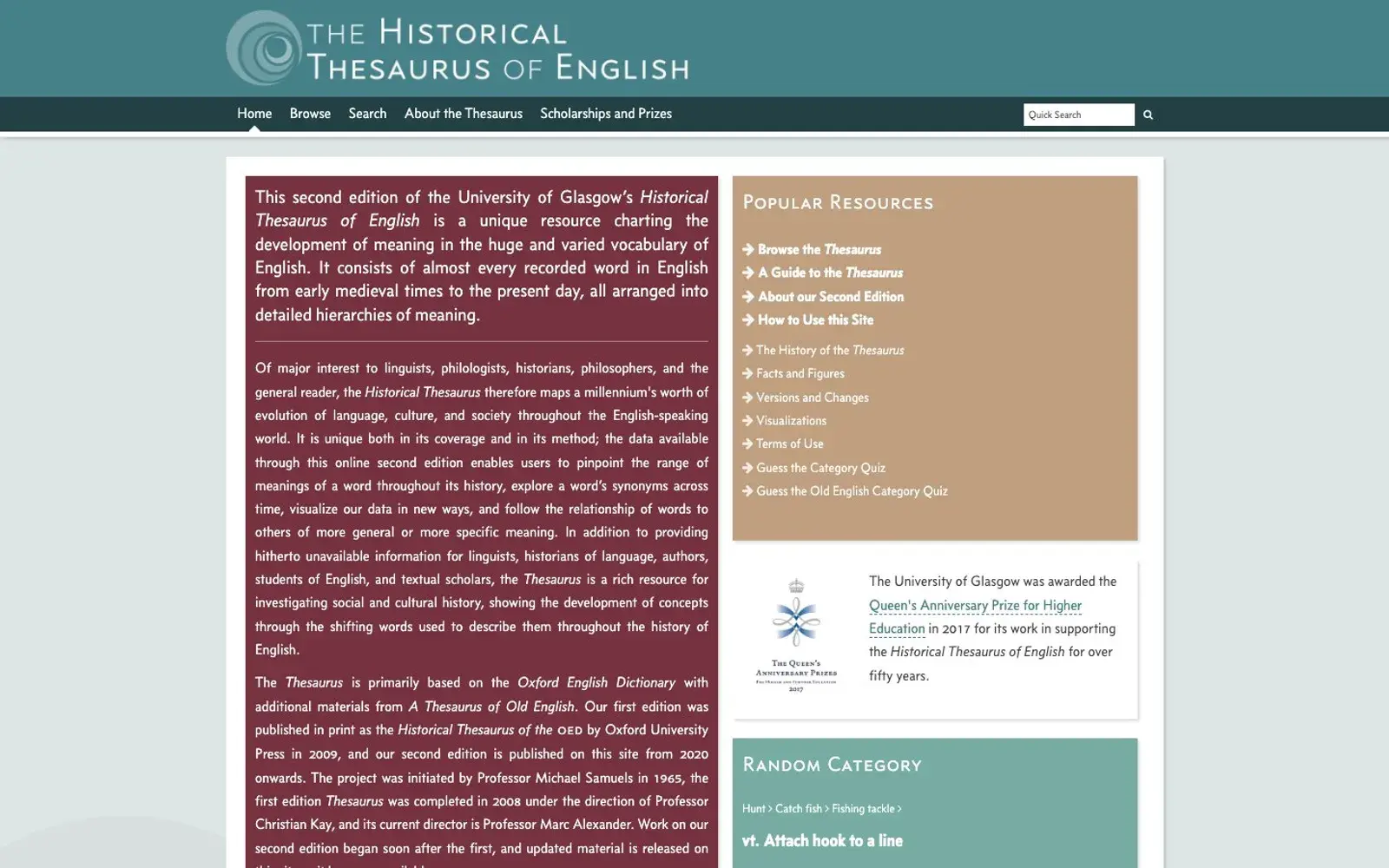
The Historical Thesaurus of English works the other way round from a dictionary. Instead of going from a word to its meaning, you start with a meaning — the moon, being drunk, dying — and see every English word that has carried it, each one dated by when it first turns up in writing and, where it applies, when it fell out of use.
It's a University of Glasgow project with a long backstory. Professor Michael Samuels started it in 1965; the first edition was finished in 2008 and printed by Oxford University Press in 2009. Since 2020 the site has hosted the second edition, which is still being added to. The material comes mainly from the Oxford English Dictionary, plus the Thesaurus of Old English.
Why we picked it
It makes the history of English visible in a way few sites do. Search "moon" and you get 29 results: Old English mona, the root of the modern word; a separate "secondary planet, satellite" category where moon only shows up from 1665; entries about eclipses. You can sort by category, first recorded date, alphabetically or by how long a word lasted, and switch on mini-timelines that draw each word's lifespan as a bar.
The Facts and Figures page is a treat in itself. The biggest categories in the whole thesaurus are "immediately" (267 words), "dull, stupid" (249), "excellent" (227), "die" (212) and "drunk" (195). The word form with the most senses is set, at 345. More than 230 people have worked on it, adding up to roughly 330,000 hours. Make of that what you will about English speakers' priorities over the centuries.
Where to start
- Search a plain word like moon, love or town and turn the mini-timelines on.
- Hit Random Category — a random branch of the tree is often better than anything you'd think to look up.
- Open Browse and work down the hierarchy; the plus icons expand each level.
- Play Guess the Category, or the harder Old English version, where you guess the meaning from a list of words.
- Read Facts and Figures for the record-holding categories and words.
Who it's for
Writers and translators hunting for a word that fits a particular period, anyone curious about where synonyms come from, English teachers and history buffs, and word nerds in general. The category codes look like library shelf marks (01.01.10.05 and so on), but they're just the address of each idea in the tree, and you can ignore them while you browse.
Quick answers
Is it free? Yes. Search, browsing, visualizations and the quizzes all work without an account.
Who runs it? The University of Glasgow; Professor Marc Alexander is the current director.
How is this different from a normal thesaurus? Every word comes with dates, so you can tell which synonyms are still alive and which died out centuries ago.