Proofs without words
Animated math proofs: eight perfect shuffles restore a deck, a false diagram claims 58 = 60, and a rolling circle is turned into a square. Barely a word needed.
What it is
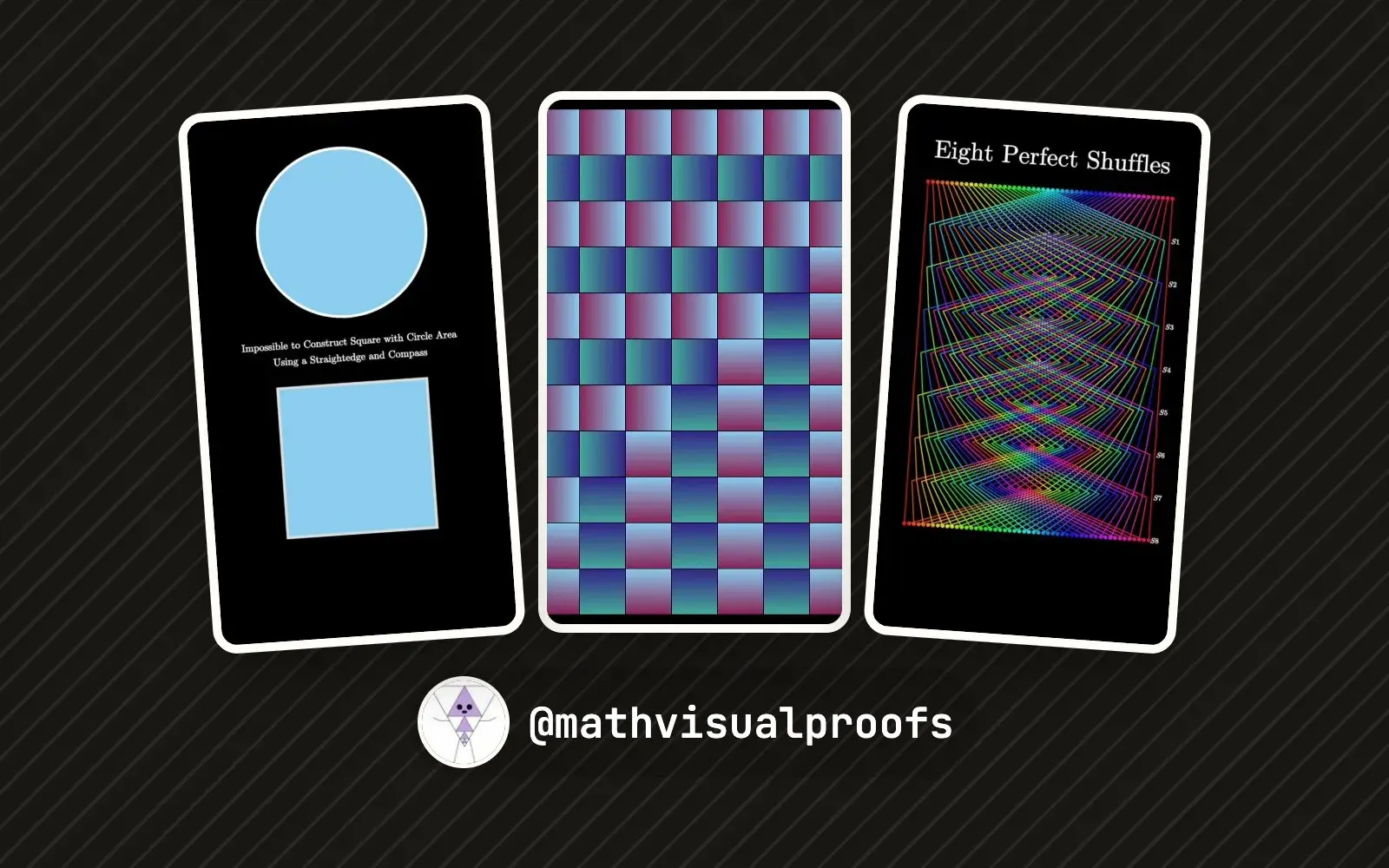
The TikTok of the creator behind the YouTube channel Mathematical Visual Proofs. He animates "proofs without words," the classic math diagrams that make a theorem obvious without a page of algebra. The animations are built with Manim, the library created by 3Blue1Brown. About 12,000 people follow the TikTok, and new clips appear several times a week. It's an English-language account, but many videos barely use words at all: just a diagram, motion and music.
Why we picked it
Because it's math you can watch like a magic trick. Eight perfect riffle shuffles bring a 52-card deck back to its original order, and the very next video shows the permutation diagram that explains why. "Does 58 = 60??" presents a picture that seems to prove nonsense, then carefully reveals where the diagram cheats. "Square a circle by rolling" gives an elegant way to get a square of equal area if the circle is allowed to roll, with an honest note that this doesn't solve the ancient problem, which allows only a straightedge and compass.
We also like that, by his own account, he tries to credit the original source of each visual proof rather than passing off other people's discoveries. A post about a shop with prints and T-shirts shows up now and then; that's the only promotion, and it doesn't get in the way.
Where to start
- "Eight Perfect Riffle Shuffles," where the deck comes home.
- "Eight Perfect Shuffles Permutation Diagram," on why it works.
- "Does 58 = 60??", a geometric paradox and its resolution.
- "Square a Circle By Rolling!", a square from a rolling circle.
Who it's for
Students who think algebra is a pile of arbitrary rules, math teachers looking for a lesson opener, and anyone who loves puzzles and beautiful diagrams.
Quick answers
Do I need to follow spoken English? Not really. Many clips rely on animation and music; titles and captions are in English.
Is it hard? Most ideas need only school math, though some are worth a second watch.
Where are the longer versions? On the Mathematical Visual Proofs YouTube channel.