Space with Dr Kirsten Banks
An Australian astrophysicist explains odd galaxies, the maths behind famous discoveries and surprising physics like scallops with telescope eyes.
What it is
Dr Kirsten Banks is an Australian astrophysicist and science communicator. Her bio reads "Astrophysicist, Science Communicator, Professional Space Yapper", and more than 630,000 people follow her. She covers space in short, fast videos with obvious delight in the subject.
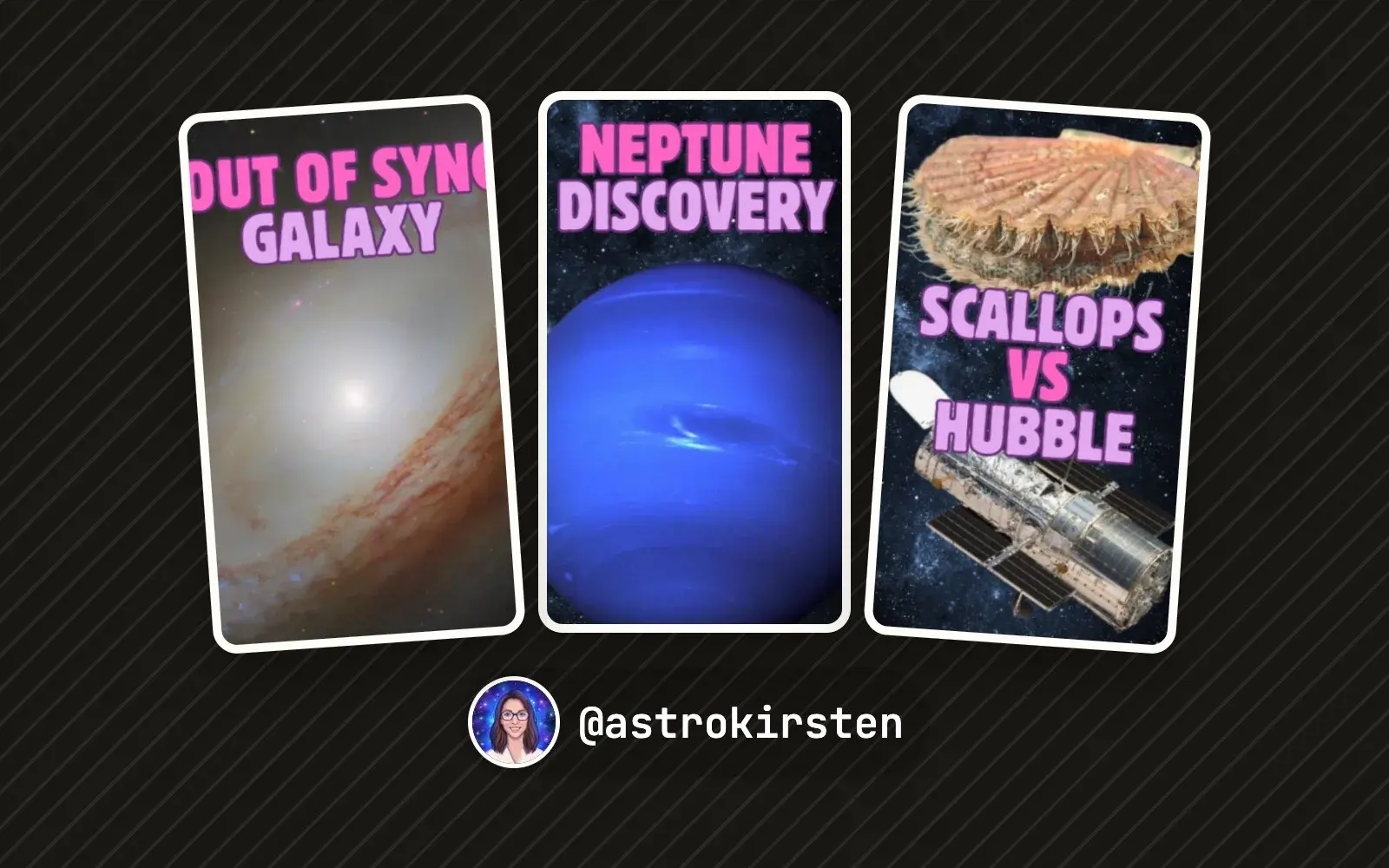
A few recent examples. NGC 4698, a spiral galaxy whose central bulge sticks out almost at right angles to its disc. The 180th anniversary of Neptune's discovery, when astronomers found the planet with calculations after noticing that Uranus was not orbiting quite the way Newton's laws predicted. And a detour into biology: scallops can have up to 200 eyes, and instead of lenses they focus light with curved mirrors, much like the Hubble Space Telescope.
Why we picked it
Kirsten is good at hooking you with a question and then answering it properly. A video opens with "this galaxy is out of sync", and a minute later you understand that the stars in its bulge and its disc rotate differently. She also steps outside astronomy when there is good physics to be had, which is how the scallops got in.
We like her stance on the platform too. In one video she explains how to tune your TikTok feed so you see more from real creators and less AI-generated content. She also has a book, "Lost in Space", available in print and as an audiobook.
Where to start
- Neptune found with maths, a classic story from the history of science in about a minute.
- NGC 4698, the galaxy with a sideways middle.
- The scallop eyes video, for the most unexpected optics lesson of the week.
- Then keep scrolling: she posts several times a week.
Who it's for
Space fans who do not want to read long articles, students and physics teachers looking for short clips, and anyone who likes science explained with personality.
Quick answers
Who is she? Dr Kirsten Banks, an Australian astrophysicist and science communicator.
Is it only about space? Mostly, but she sometimes covers biology or physics when there is a link to astronomy.
Does she have a book? Yes, "Lost in Space", which she mentions in her videos.