The Aswang Project
A free, source-minded guide to Philippine mythology and folklore: creatures, spirits and deities sorted by region, with new articles every week.
What it is
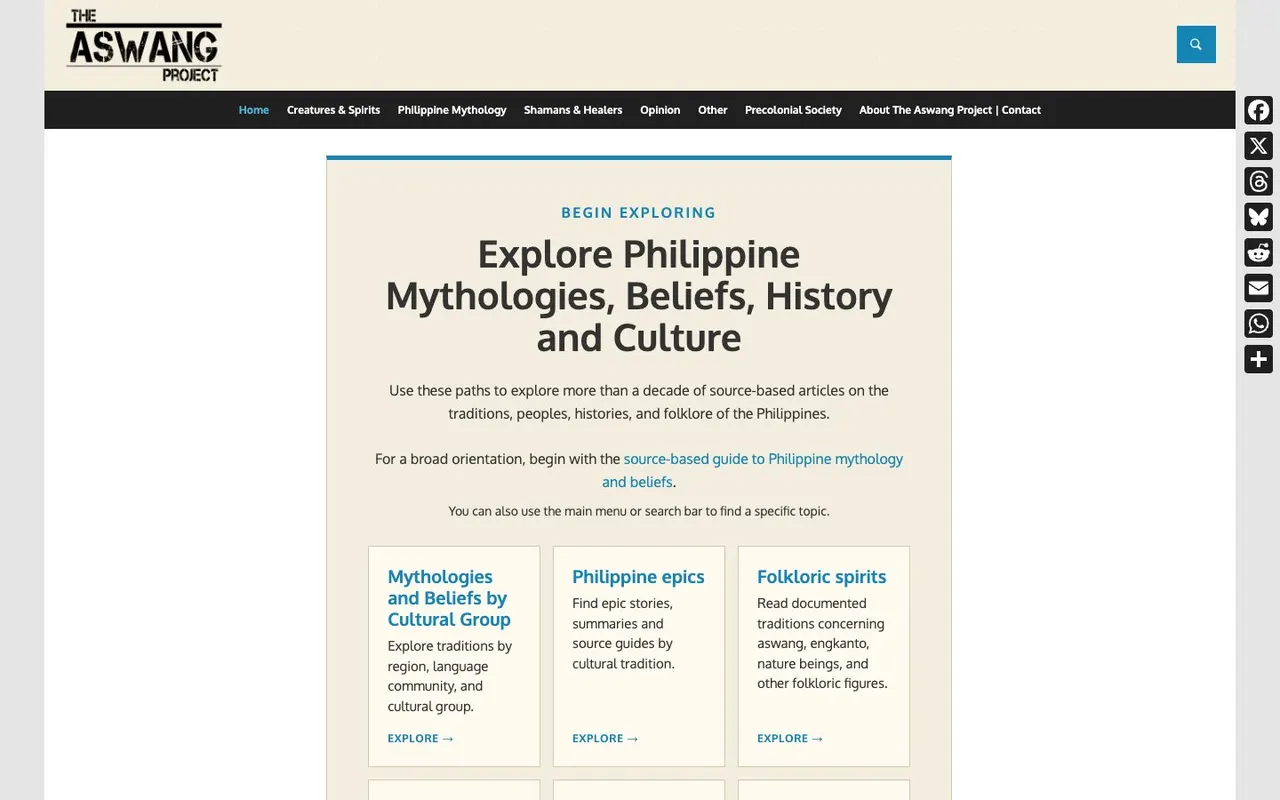
The Aswang Project is a website about the folklore and mythology of the Philippines. It describes itself as a free resource exploring the cultures, folklore and mythologies of the archipelago, and it has been running since 2015. New pieces land several times a month: in September and early October 2026 alone there were articles on the tiyu-an, the long-lipped oko, a manananggal sighting in Hawaii, an interview about a classic tiyanak film, and a piece on the Gold Tara of Agusan, the famous gold figure found in Mindanao.
The name undersells it. The aswang is just the most notorious Philippine monster, a shape-shifting flesh-eater used to scare children across the country. The site goes much wider: a bestiary of creatures and spirits, a mythology section on deities, plus sections on shamans and healers, precolonial society, urban legends and interviews.
Why we picked it
The Philippines is more than seven thousand islands and dozens of peoples, each with its own gods and its own things that go bump in the night. Pop listicles tend to flatten all of that into "Filipino monsters." The Aswang Project does the opposite. Mythology is organised by tradition: Bikolano, Cordilleran, Ilokano, Tagalog, Visayan, Mindanao and Palawan. The mythology hub explains why regional attribution matters and why local beliefs shouldn't be merged, and it breaks down the kinds of sources involved, from early Spanish accounts to ethnography, living tradition and modern retellings.
That's what makes it worth your time. A piece on moon deities reads as a guide to the sources: who recorded what, when, and where people actually believed it. It still has a sense of humour, though. A headline about an aswang ruled by "eternal puppies" turns out to be a serious look at a local variant of the belief.
Folklore is also a good lens on the country itself. How the Tagalog pictured the afterlife, who the diwata and anito are, how Spanish colonisation reshaped older beliefs, why a monster from 1980s horror films still haunts a generation: all of that is Philippine history told through its fears and stories.
Where to start
- Open Creatures & Spirits and read up on the aswang, the manananggal and the tiyanak, the three best-known figures.
- Go to Philippine Mythology and pick one tradition, say Visayan or Cordilleran, so the picture stays coherent.
- Read the section on how sources are presented; it teaches you to tell a sixteenth-century record from a modern invention.
- Browse Interviews for conversations with filmmakers, artists and researchers who work with folklore.
- When you want more depth, Books & References lists titles on Philippine mythology, history and culture.
Who it's for
Anyone into mythology and comparative folklore who has already been through the Greek and Norse canon and wants something genuinely new. Fantasy writers, illustrators, game designers and screenwriters looking for fresh creatures and wanting to handle them with respect. Travellers who want to understand the stories they hear in Cebu or Bohol. Filipino readers abroad reconnecting with the tales their grandparents told. The English is clear and friendly, with none of the weight of an academic journal.
Quick answers
Is it free? Yes, every article is open to read. There's a separate page with a curated list of books for sale, but no paywall or sign-up.
Is it only about monsters? No. Alongside the bestiary there are deities, healers, precolonial society and interviews, all sorted by region.
Does it present the beliefs as real? It treats them as culture: where a belief comes from, who recorded it and how it changed over time.