Matenadaran manuscripts
The website of Yerevan's Matenadaran, the great repository of Armenian manuscripts: stories behind individual Gospels and books, a map of miniature-painting schools, catalogues and a digital library.
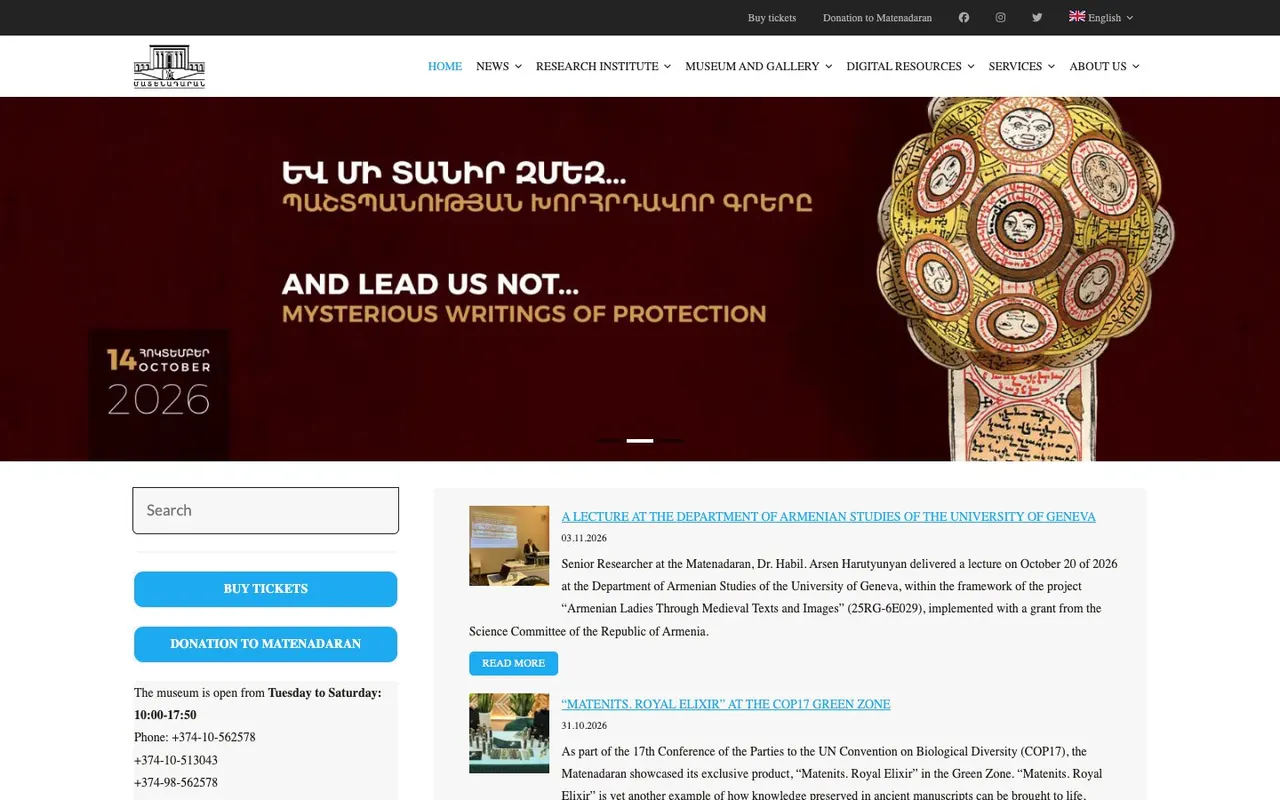
What it is
The Matenadaran — formally the Mesrop Mashtots Research Institute of Ancient Manuscripts in Yerevan — is both a research centre and a museum. Its website runs in Armenian, English and Russian. Beyond visitor information, it has a "Digital Resources" section with a digital library, a main catalogue of manuscripts, a database of medieval Armenian authors, old printed books, maps and the institute's academic bulletin.
The best part for non-specialists is the "Manuscripts" section: illustrated articles about individual books in the collection. There's the Etchmiadzin Gospel, copied in 989; the Gospel of the village of Mzuk, written in 1454 in what was a medieval writing centre; the Charsanjak Gospel, copied in 1471 in Jerusalem and kept in a silver binding; and a 1684 Gospel from Kafa, an example of the Crimean school of Armenian miniature painting by the scribe and painter Nikoghos Melanavor. Other pieces cover whole types of books — sermon collections, Mashtots ritual books and the musical manuscripts known as "treasuries".
Why we picked it
Armenia has one of the world's oldest book cultures, and the Matenadaran is its heart. Most people will only see the museum if they travel to Yerevan; the website lets you meet the manuscripts from anywhere. The short articles read like small detective stories: where a book was copied, who illuminated it, how it survived its journeys, and why one Gospel was believed to heal.
We also like the map "The Schools of Miniature Painting of Western Armenia and Cilicia in 10th–15th Centuries", prepared at the Matenadaran by Karen Matevosyan. It shows where scriptoria worked and how many famous manuscripts are tied to each, turning Armenian miniature art into geography. The news section shows a living institution, with exhibitions, conferences and restoration work.
Where to start
- Open "Manuscripts" and read the article on the Etchmiadzin Gospel.
- Then read about the 1684 Gospel from Kafa to see how far the Armenian book tradition travelled.
- Look at the miniature-schools map under Digital Resources → Maps.
- Browse the Medieval Armenian Authors database.
- Planning a visit? The museum is open Tuesday to Saturday, 10:00–17:50.
Who it's for
Anyone into the history of the book, calligraphy and medieval art; travellers heading to Armenia; and members of the Armenian diaspora who want to know their heritage better. Coverage can vary between language versions, but the English side has plenty to read.
Quick answers
What is the Matenadaran? The Mesrop Mashtots Research Institute of Ancient Manuscripts in Yerevan — a research centre and museum.
What languages is the site in? Armenian, English and Russian.
Can I see manuscripts online? The articles in "Manuscripts" include photos, and Digital Resources offers a digital library and catalogue.