Japan Search: Japan's archives, together
Japan's national search across digital archives: 320 databases and nearly 33 million prints, photos, scrolls and archaeological finds, with an English interface and curated galleries.
What it is
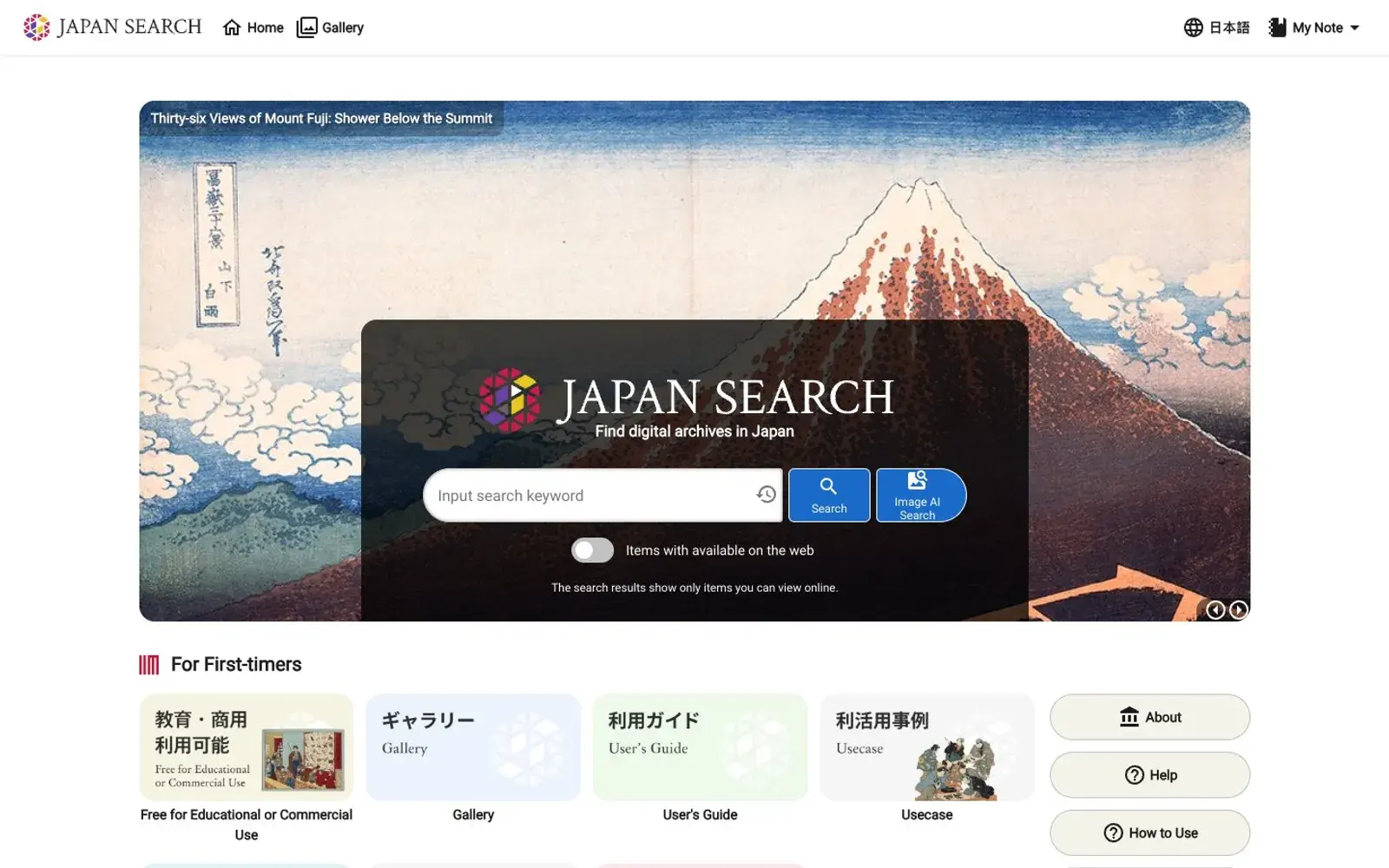
Japan Search is a single search platform for Japan's digital archives. It is run by the National Diet Library together with museums, libraries, archives and universities across the country. The home page lays out the scale: 320 connected databases and 32,848,991 records. One search box pulls up ukiyo-e prints, old maps, photographs, theatre posters, archaeological finds and natural history specimens.
There is an English version of the site. Menus, filters and some of the collections are translated. Many item descriptions stay in Japanese, but the images carry most of the weight anyway.
Why we picked it
Browsing Japanese collections usually means hopping between dozens of separate museum websites. Here they sit side by side, and you notice it right away: a search for "Fuji" or "cat" returns material from wildly different institutions.
The best part is the Gallery section, a set of curated showcases put together by partner organisations. We found a collection of ghosts, demons and monsters in Japanese art, a story about the excavation of the Toro settlement in Shizuoka, and fossils from the ancient Chichibu Bay. They read like small online exhibitions, and an hour disappears quickly.
The platform keeps growing. In August 2026 it added another museum from Kanazawa.
Where to start
- Switch to English and open Gallery, the friendliest way in.
- Start with the Yurei-Yokai Collection of ghosts and monsters.
- Try a simple English keyword: mountain, cat, wave, shrine.
- Tick Free for Educational or Commercial Use if you want images you can reuse.
- Check the partner list to see whose collections feed the results.
Who it's for
Anyone who loves Japanese prints, history or visual culture. Designers and illustrators hunting for reference material. Teachers and students who need sources with clear provenance. And anyone curious to see Japan through the eyes of its own museums.
Quick answers
What language is the site in? The interface is available in Japanese and English. Many item descriptions and some galleries are Japanese only.
Who runs it? The National Diet Library of Japan, working with partner institutions.
Can I reuse the images? It depends on the item. There is a dedicated filter for freely usable material.